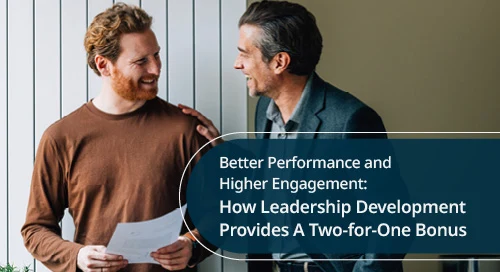
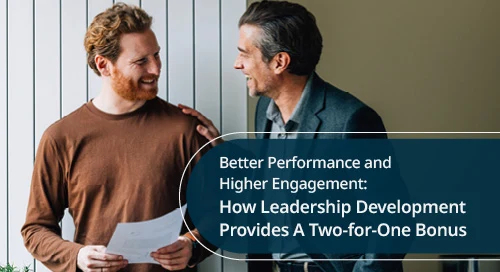
Better Performance and Higher Engagement: How Leadership Development Provides A Two-for-One Bonus

 A recent Blanchard study and real-world data from leadership development initiatives make a compelling case: investing in leadership development directly improves both engagement and retention. And it creates measurable, sustained impact across teams and organizations.
Leadership Shapes the Employee Experience
At their core, employee engagement and performance reflect how emotionally invested people are in their work and their organization. Engaged employees don’t just complete tasks—they bring energy, commitment, and discretionary effort.
But engagement doesn’t happen in a vacuum. Blanchard Leadership-Profit Chain research shows that engagement is heavily influenced by leadership behaviors.
Leaders define the day-to-day experience of employees. They set expectations, provide feedback, offer support, and create the conditions for success. When leadership is effective, employees feel valued, understood, and motivated. When it’s not, even the best strategies fall flat.
This is where leadership development becomes critical.
From Training to Transformation: Measuring Real Impact
As a leadership development company specializing in performance management communication skills, Blanchard has always been invested in measuring impact across multiple levels—from initial reactions to long-term business outcomes. This includes
- increased knowledge and confidence;
- observable behavior change;
- performance improvement;
- engagement and
- intent to stay (retention).
Toward that end, we recently completed a study of more than 4,000 participants in our SLII® leadership training. SLII® is Blanchard’s flagship program that teaches three foundational leadership skills: goal setting, diagnosing competence, and providing a matching leadership style.
The data told a compelling and multi-faceted story. As an immediate experience,
- 98% found the content relevant to their role;
- 97% of participants believed the training would improve their performance; and
- 98% would recommend the workshop to others.
That’s a good start, because confidence is the foundation for behavior change. Leaders who feel capable are more likely to apply what they’ve learned. But the more interesting question is: did anything stick?
Behavior Change: Where Engagement Starts to Shift
Three months later the answer was yes, according to the participants’ direct reports.
Ninety days after training, both leaders and their direct reports reported noticeable changes in leadership behavior. In fact, 72% of direct reports reported “Significant” or “Exceptional” improvement, 25 points higher than the leaders’ self-report of improvement.
That gap matters. It suggests the changes weren’t just internal (“I feel more confident”), they were visible to others (“I saw my leader improve”).
And that’s where engagement starts to move.
The Ripple Effect: Engagement and Retention
When leaders change how they show up, it doesn’t stay contained. It ripples outward.
In this case, the ripple was pretty clear:
- 90% of leaders reported higher engagement and motivation as a result of the development opportunity.
- 76% of employees said they felt more engaged because of their leader’s improvements.
- 86% of leaders felt more committed to staying as a result of the development opportunity.
- 79% of employees said they felt more committed to staying as a result of their leader’s improvements.
These aren’t small bumps. They point to a shift in how people experience their work and whether they see a future where they are.
It’s easy to think of leadership development as something that benefits the leader. But the bigger story is what happens to everyone around them.
Why It Works (Without the Jargon)
At a practical level, the leadership behaviors that improve through training aren’t complicated. They fall into two broad categories:
- Being clear (What are we doing? What does success look like?)
- Being supportive (Do you have what you need? Are you being heard?)
When leaders get better at both, something fairly intuitive happens:
- people trust them more;
- work feels more manageable;
- expectations are less ambiguous;
- feedback becomes useful instead of stressful.
And these conditions—clarity and support—are some of the same ones that research has been linking to engagement for years.
The Retention Equation: Leadership as a Strategic Lever
Leadership development isn’t just about improving metrics, it’s also about shaping culture.
When employees see their leaders growing and their organization investing in that growth, they interpret it as a signal: this organization values people. Leadership development creates a multiplier effect where one trained leader impacts the engagement of every person they lead.
Organizations that invest in developing leaders create environments where
- feedback is frequent and constructive;
- employees feel supported in their development;
- communication is clear and consistent; and
- trust and accountability are high.
When employees receive the leadership they need, they are more likely to behave in ways that benefit the organization and remain committed over time.
The Bottom Line
Leadership development is a strategic driver of engagement and retention. In a time when engagement is declining and retention is under pressure, organizations don’t need to look any further than investing in their leaders.
The evidence is clear. When organizations invest in leadership development,
- leaders become more capable and confident;
- leader behaviors change in observable ways;
- leaders and direct reports become more engaged; and
- leaders and direct reports become more committed to staying.
Investing in leadership development isn’t just an investment in people—it’s also an investment in performance, culture, and long-term organizational success.