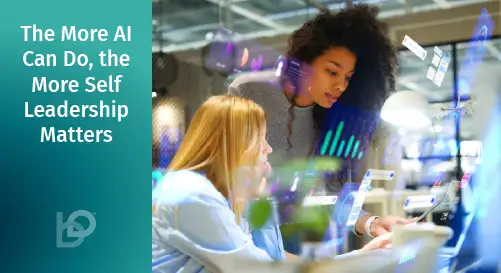
The More AI Can Do, the More Self Leadership Matters

 More than 20 years ago Ken Blanchard, Susan Fowler, and Laurence Hawkins published Self Leadership and the One Minute Manager, a book that introduced the three mindsets of Self Leadership: owning your path, challenging your assumed constraints, and activating your power. As AI becomes increasingly embedded in our work, those mindsets are more important than ever.
Artificial intelligence is changing the workplace at an astonishing pace. It can locate and identify information that once took hours or even days to find. It can summarize reports, analyze data, generate ideas, write first drafts, and answer questions in seconds.
When generative AI first entered the workplace, simply using it was a competitive advantage. As AI becomes more widely available, the competitive advantage increasingly comes from the human being behind the technology—those who are leveraging their judgment and values to guide AI toward desired outcomes.
Owning Your Path in the Age of AI
Self-leaders are proactive in setting their chosen path. They don’t expect others to read their minds—they ask for the information they need to succeed. They don’t wait for someone else to tell them what to do—they establish goals and ask for direction and support to achieve them.
That autonomous mindset isn’t just a leadership ideal—it has personal benefits. In a nationally representative survey of nearly 7,000 adults, Gallup and the Walton Family Foundation found that “a sense of personal agency, the feeling that you can shape your own path,” was the strongest predictor of whether Americans were thriving in their lives.
In other words, the freedom people feel to own their own path directly correlates with their sense of wellbeing.
With the help of AI, self-leaders can take even greater ownership of their personal development. They can use AI to generate a variety of ways to achieve their stated goals. They can employ it to explore an unfamiliar topic, think through a challenging problem, and discover hidden resources.
AI doesn’t create a proactive mindset, but it does reward it. Used well, it becomes an always-available partner to provide help along the path.
Using AI to Help Challenge Assumed Constraints
One of the most powerful habits of self-leaders is to question limiting beliefs. A self-leader is not afraid to scrutinize “common knowledge,” processes, and procedures that are based on past experience. They don’t buy that “the way it is” is etched in stone—they challenge assumed constraints.
To illustrate how absurd assumed constraints can be, Susan Fowler—coauthor of Self Leadership and the One Minute Manager—tells the story about catching grasshoppers in a glass jar as a child. The grasshoppers repeatedly jumped up and hit the lid. After a while, they learned to jump only as high as the lid allowed. Later, when the lid was removed, the grasshoppers still only jumped to the height where the lid had been. They were physically free to escape, but they had learned a limit that no longer existed.
Like the grasshoppers, many of us continue to live beneath invisible lids of our own making.
I’m not creative.
I’m not good with numbers.
I need my manager to tell me what to do next.
AI can be a partner in challenging assumed constraints. It can help us create, calculate, and plan our work, while also encouraging us to question our own thinking and exposing weaknesses in our approach.
What AI cannot do is determine whether the creation is worthy, the calculations are useful, or the work plan is prudent. These assessments require taste, judgment, and self-knowledge—human abilities unavailable to AI.
Activating Powers that AI Can’t Replace
The third skill of self-leaders is the ability to activate their power by leveraging their strengths and sources of influence.
Many people believe that power comes primarily from a position or title. Self Leadership teaches that position power—the influence that derives from a title—is just one of several sources of power. Regardless of where we sit in an organization, we have other forms of power available to us:
- Knowledge Power: Expertise; the ability to acquire and apply knowledge.
- Personal Power: The ability to assure people and gain their confidence.
- Relationship Power: Having access to a network of others who can help us get things done.
- Task Power: The skill or ability to do something other people can’t.
AI can amplify some of these sources of power. For example, it can help us gain expertise, communicate more clearly, and enhance our ability to complete tasks.
But personal power and relationship power still depend on how we show up every day. Credibility, trust, empathy, and integrity are earned through our actions—not generated by technology.
While AI can generate a list of contacts complete with addresses and phone numbers, it cannot create a network of support based on trust, emotional connection, and friendship.
The Human Advantage
As AI becomes more capable, many technical skills will become easier to acquire. Information will become easier to access. Routine work will become increasingly automated.
What won’t become automated are the distinctly human qualities that Self Leadership has always emphasized: personal initiative, the courage to challenge assumptions, and the emotional skills required to develop and sustain relationships.
AI can generate ideas for moving forward, but it’s the self-leader who decides which of those ideas have merit. AI can generate recommendations, but the self-leader remains accountable for the quality and consequences of those recommendations. AI can generate strategies, but the self-leader determines what is ethical, fair, and in the best interest of themselves, their clients, their customers, and their colleagues.
As technology takes on more of the work, those distinctly human responsibilities—taking ownership, asking questions, and acting with intention and integrity—become even more valuable.
The more AI can do, the more Self Leadership matters.