A Common Language to Unlock Team Results
 Ask five people on the same team what their team needs to be more effective, and you'll get five different answers. One person points to better communication. Another names improved alignment. A third wants clearer roles. The differences are real: each person notices something true from where they sit.
Because a team rarely holds a single picture of its priorities, it’s important for team members to come together and name two things: 1) what they already do so well that their team can be a role model for the rest of the organization, and 2) what capabilities they still need to develop.
High-performing teams remain central to how organizations succeed. As Harvard Business Review editor in chief Amy Bernstein writes, teams with a shared sense of purpose “consistently pull together to deliver on even the most ambitious goals.” The challenge for most teams is agreeing, together, on where to focus their efforts, and aligning with shared language to describe their priorities.
The Team Wheel: Creating Focus with a Shared Language
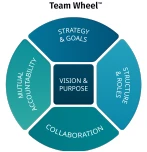 When a team has a clear way of identifying and defining the dimensions of teamwork that contribute to high performance, it becomes easier to recognize the team’s strengths and see opportunities for improvement. Our research and experience point to five key dimensions of team effectiveness that shape how a team creates value together.
- Vision & Purpose
The team creates a clear picture of the future it is working toward, defines why it exists, and describes how it contributes to the organization. - Strategy & Goals
The team translates its vision and purpose into clear, strategic priorities and measurable goals, and creates an actionable roadmap to achieve them. - Structure & Roles
The team confirms the membership, clarifies roles and responsibilities, and defines how it will work, including how decisions will be made, to achieve its goals. - Collaboration
The team establishes shared norms and collaboration practices to build the trusted relationships necessary to achieve its goals. - Mutual Accountability
Team members work together to deliver on commitments, achieve results, and continuously improve their effectiveness and performance.
This simple, easy-to-navigate wheel is key to identifying what team effectiveness actually looks like. It gives the team a common language for focusing on and achieving operational excellence.
To Get Aligned, Name Your Team’s Strengths and Focus Areas
Each of the five key dimensions in the Team Wheel includes specific focus areas a team can choose to strengthen. Within Structure & Roles, for example, a team might focus on decision making, examining how decisions are made. Within Collaboration, a team might focus on communication practices, reviewing how information is shared and how team members stay connected between meetings.
Picture a leadership team that sits down together and names its strengths: exceptional clarity on Vision & Purpose and Strategy & Goals, something other teams already look to them to model. In the same conversation, they name their focus area for the quarter: decision making within Structure & Roles. Everyone hears the same language, agrees on the same focus area, and measures progress against the same picture of success.
A cross-functional launch team might identify Vision & Purpose as a strength and communication practices within Collaboration as a focus area—especially if team members have critical information that others need to do their work effectively. Different teams will identify different strengths and focus areas. What matters is that the team names both together.
Naming and agreeing on the team’s strengths and focus areas in the same meeting is itself an act of alignment. This process clarifies for each member, including the team’s leader, what to keep doing well and where to focus their energy in the weeks ahead. It also gives the team and others in the organization a clear, shared standard of what to role model, what not to role model, and where to look for progress to see whether the effort is paying off.
Check Your Team’s Alignment
When a team is not aligned, the cost shows up quickly. Atlassian’s 2025 State of Teams report, based on a survey of 12,000 knowledge workers and 200 executives, found that half of knowledge workers say teams inside their company end up duplicating each other’s efforts without realizing it, and only 7 percent of executives feel confident they know how each team’s efforts connect to the organization’s larger goals. The same research found that teams that align their efforts with shared goals are more than twice as likely to focus on what matters most and about five times as likely to meet their deadlines.
A common language for team effectiveness and a shared choice about where to focus turn intention into operational excellence, day after day, meeting after meeting, quarter after quarter.
You don’t have to tackle all five dimensions of team excellence at once. In fact, that rarely works. Giving time and attention to just a few focus areas makes progress easier to achieve. Plus, it doesn’t have to be complicated. In your next team meeting, ask a few simple questions:
- What does our team do well enough to serve as a model for the rest of the organization?
- Have we named, together, at least one focus area to improve and develop?
- If asked individually, would every person on our team identify that same focus area?
Every team already has strengths worth naming and focus areas worth developing. The Team Wheel provides a common language to help teams do just that. Teams that build on their strengths and address areas that need improvement are the ones who can more easily deliver on ambitious goals and achieve extraordinary results.
Alexander Caillet, Janice Caillet, and Lael Good lead the Blanchard Teams practice. Each brings more than 25 years of experience helping teams, from newly formed groups finding their footing to senior leadership teams navigating complex organizations.